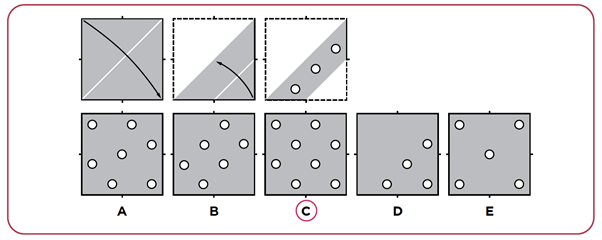
CAT4 Figure Analysis practice sample questions


Spatial Reasoning · CAT4 subtest guide

CAT4 Figure Analysis Practice:
Questions, Examples and Strategies

Learn how CAT4 Figure Analysis questions work, how pupils can
visualise folds and punches, which mistakes commonly reduce
accuracy and how to prepare without over-coaching.

Subtest overview

What is CAT4 Figure Analysis?

CAT4 Figure Analysis is one of the eight
CAT4 subtests and contributes to the
Spatial Reasoning battery.

Pupils are shown a piece of paper being folded one or more
times. A hole or shape is then punched through the folded
paper. They must work out how the complete paper would look
after every fold is opened.

The task requires pupils to mentally reverse each fold while
keeping track of the punch position. Every fold acts like a
line of reflection, so the punch is reproduced symmetrically
when the paper is unfolded.

Harder questions may involve several folds, diagonal folds,
punches close to an edge or fold line, and answer options
containing plausible but incorrectly placed holes.

Figure Analysis does not depend on taught mathematical
formulas. It samples spatial visualisation, mental
transformation and the ability to hold several stages of
information in mind.

Key distinction:

Figure Analysis asks pupils to mentally unfold a punched
shape. Figure Recognition asks pupils to find a target shape
hidden inside a more complex design.

Skills involved

  • Mental folding and unfolding
  • Tracking lines of symmetry
  • Reflecting positions across fold lines
  • Holding several transformations in mind
  • Predicting the final number of holes
  • Distinguishing reflection from rotation

How questions work

Figure Analysis rules pupils need to recognise

Every fold creates a reflection

When a folded section is opened, the punch is mirrored across
the fold line.

The new hole should appear the same distance from the crease
as the original hole.

One fold usually doubles the punch

A single punch through paper folded once normally produces two
matching holes when the paper is opened.

This can change when the punch lies directly on a fold or
boundary.

Two folds may create four positions

When paper is folded twice, the punch may be duplicated across
both crease lines.

Pupils should unfold one stage at a time rather than attempting
to jump directly to the final answer.

The order of unfolding matters

The final fold is normally opened first during mental
reconstruction.

Reversing the wrong fold first can place holes in incorrect
quadrants.

Fold lines control orientation

A vertical fold creates a left-right reflection. A horizontal
fold creates an up-down reflection.

Diagonal folds create reflections across the corresponding
diagonal line.

Edge and crease punches require care

A punch directly on a fold line may not produce two separate
holes when opened.

A punch close to an outer edge may create a cut-out or partial
shape on the final boundary.

Shape orientation can also reflect

When the punch is not circular, its orientation may reverse
across the crease.

Pupils must track both position and direction.

Symmetry provides a final check

The completed pattern should normally be symmetrical around
every fold line used in the question.

An answer lacking this symmetry can usually be rejected.


Understanding the task

What strong Figure Analysis reasoning looks like

Strong Figure Analysis reasoning is systematic. The pupil does
not try to imagine the finished answer in one leap.

Instead, they identify each fold line, begin with the final
fold and mentally open the paper one stage at a time.

At each stage, the punch is reflected across the crease. The
pupil checks its distance from the fold and whether its
orientation should also reverse.

Once every fold has been opened, the pupil counts the final
holes and checks that their arrangement has the expected
symmetry.

Work backwards

The diagrams normally show the order in which the paper was
folded. To solve the problem, reverse that order.

Use the crease as a mirror

Imagine that the fold line is a mirror. Place the duplicated
punch the same distance on the opposite side.

Count after each stage

Keeping a running count can prevent pupils from losing holes
during multiple unfolding steps.


Original illustrative example

A worked CAT4 Figure Analysis example

Question

A square piece of paper is folded vertically from left to right.
One circular hole is punched near the right-hand outer edge of
the folded paper. What will appear when the paper is opened?


Step 1: identify the fold line.

The paper has one vertical crease through its centre.


Step 2: open the fold mentally.

The punch remains in its original position and is reflected
across the vertical crease.


Step 3: check spacing.

The two holes should appear at equal distances from the centre
fold.

Answer:

The fully opened square contains two horizontally aligned
holes, symmetrically positioned on opposite sides of the
centre crease.

This is an original illustrative example created to explain the
reasoning process. It is not a live or copied CAT4 item.

Four-step method

A reliable CAT4 Figure Analysis strategy

Step 1: identify every fold

Note whether each fold is vertical, horizontal or diagonal.

Keep track of the order in which the folds were made.

Step 2: reverse the final fold

Begin with the last fold shown and open it mentally.

Reflect each punch across that fold line.

Step 3: repeat one fold at a time

Continue reversing the folds in order.

At every stage, duplicate all current punches across the new
crease where appropriate.

Step 4: count and check symmetry

Count the expected holes and compare their spacing.

Reject options that break the symmetry created by the folds.


Diagnostic preparation

Common Figure Analysis mistakes

Common mistakeWhat may be happeningBetter habit
Rotating the punch instead of reflecting it The pupil recognises that the position changes but applies
a turn rather than a mirror transformation.
Treat every crease as a mirror line.
Forgetting the order of multiple folds The pupil attempts to imagine the final result in one step. Reverse the final fold first and work backwards.
Doubling every punch automatically The pupil does not check whether a punch lies on a fold
line or boundary.
Check the exact punch position before duplicating it.
Losing track of existing holes During a second unfolding stage, only the original punch
is reflected rather than every current punch.
Count and track all holes after each unfolding stage.
Ignoring hole orientation The pupil tracks position but overlooks that a non-circular
punch can also be reflected.
Check both location and direction after every fold.
Choosing an option with the right count but wrong spacing The pupil uses hole number as the only checking rule. Compare distance from each crease as well as total count.


Difficulty progression

How Figure Analysis questions become harder

One straight fold

Introductory questions may use one vertical or horizontal fold
and one circular punch.

Two successive folds

Pupils must reverse the folds in order and keep track of all
duplicated holes.

Diagonal folds

Reflection across a diagonal can be harder to visualise than a
vertical or horizontal reflection.

Punches near folds or edges

The final pattern may contain overlapping, partial or boundary
holes.

Non-circular punches

Pupils must track the orientation of a triangle, notch or other
directional shape.

More plausible distractors

Incorrect options may show the correct number of holes but use
rotation, incorrect spacing or the wrong unfolding order.

Practice planning

How parents and tutors should use Figure Analysis practice

Begin with physical folding

Using scrap paper can help a pupil understand how a punch is
reflected when one or two folds are opened.

Move gradually from physical demonstration to mental
visualisation.

Ask for each unfolding stage

Rather than requesting only the final answer, ask the pupil to
describe what appears after the first fold is opened.

Use symmetry as a check

Encourage the pupil to identify which fold lines should become
axes of symmetry in the completed pattern.

Review near-miss answers

Discuss whether each distractor reflects the wrong fold order,
a rotation error, a counting error or incorrect spacing.

Add timing gradually

Begin untimed and introduce short timed sets only after the
unfolding method is reliable.

Keep results in context

Figure Analysis is one CAT4 subtest. Interpret it alongside
Figure Recognition and the pupil’s wider CAT4 profile.


Paired subtest

Figure Analysis compared with Figure Recognition

Figure Analysis

Pupils mentally unfold a folded and punched piece of paper and
predict the final arrangement of holes or shapes.

The emphasis is on mental transformation, reflection and
spatial sequencing.

Figure Recognition

Pupils locate a target shape hidden inside a more complex
design.

The emphasis is on visual discrimination, exact line matching
and mental rotation.


Open the CAT4 Figure Recognition guide


Frequently asked questions

CAT4 Figure Analysis FAQs

What is CAT4 Figure Analysis?

It is one of the eight CAT4 subtests. Pupils mentally unfold a
folded and punched piece of paper and identify the final
arrangement of holes or shapes.

What does CAT4 Figure Analysis measure?

It samples spatial visualisation, mental folding and unfolding,
reflection, symmetry and the ability to hold several
transformations in mind.

How should a child practise Figure Analysis?

Begin with untimed questions and physical paper-folding
demonstrations. Ask the child to reverse one fold at a time
before introducing short timed sets.

Does one fold always create two holes?

Usually, but not always. A punch directly on a fold line or edge
may produce a different final result, so the exact position must
be checked.

Why is symmetry useful?

Each fold acts as a reflection line. The completed pattern should
normally display the symmetry created by those folds.

Is Figure Analysis the same as Figure Recognition?

No. Figure Analysis involves mentally unfolding paper. Figure
Recognition involves locating a target shape within a complex
design.

Does one weak subtest determine the whole CAT4 result?

No. CAT4 reports separate performance across batteries and
subtests. Figure Analysis should be interpreted within the
pupil’s wider CAT4 profile.

Continue your CAT4 preparation

Use the main CAT4 guide for year-group practice, free samples and
general preparation. Use the scores guide when interpreting
Standard Age Scores, stanines and uneven profiles.